Jasmine tea to water ratio is the secret behind brewing one of the most famous scented teas in China that’s rapidly gaining worldwide popularity. However, achieving that perfect cup isn’t just about tossing leaves into hot water and hoping for the best.
When brewing jasmine tea, temperature plays a crucial role in extracting the perfect balance of flavors. For optimal results, you’ll want water between 160-180°F (71-82°C), or more specifically 175-185°F for green-based jasmine teas to avoid bitterness. But temperature is just the beginning – steeping time matters too, with most experts recommending 2-4 minutes or 2-3 minutes for the ideal balance.
For high-quality varieties like Yin Hao and Dragon Pearls (which undergo up to nine scenting processes compared to just a few for standard grades), getting these details right is even more important. That’s why we created this guide – to help you master the perfect jasmine tea brewing technique and unlock its delicate flavor profile and aromatic floral scent.
Ready to brew jasmine tea like a master? Let’s dive into everything you need to know about perfecting your technique!
Understanding Jasmine Tea Types and Forms
To appreciate the complexities behind brewing jasmine tea properly, first understand the varieties that affect your perfect jasmine tea to water ratio. The type and form of jasmine tea you choose significantly impacts how much water you’ll need and what temperature will extract the best flavors.
Jasmine green, white, and black tea bases
While green tea serves as the most common base for jasmine tea, other varieties offer distinctive flavor profiles worth exploring. Green tea naturally absorbs jasmine aroma effectively, creating that classic fragrant cup many tea lovers recognize. Although less common, white, black, and oolong tea bases produce fascinating alternatives with unique characteristics.
White tea-based jasmine creates a remarkably sweet, mellow experience with elegant subtlety. For those seeking more robust flavors, jasmine black tea combines bold, malty notes with floral sweetness. Meanwhile, jasmine oolong delivers a complex profile with creamy undertones that complement the floral essence.
The base tea selection fundamentally determines not only flavor but additionally how you’ll need to adjust your brewing parameters, particularly water temperature. Generally, green-based jasmine requires cooler water than black-based varieties to prevent bitterness.
Loose leaf vs pearls vs tea bags
Jasmine tea comes in several distinct forms beyond just the base tea type:
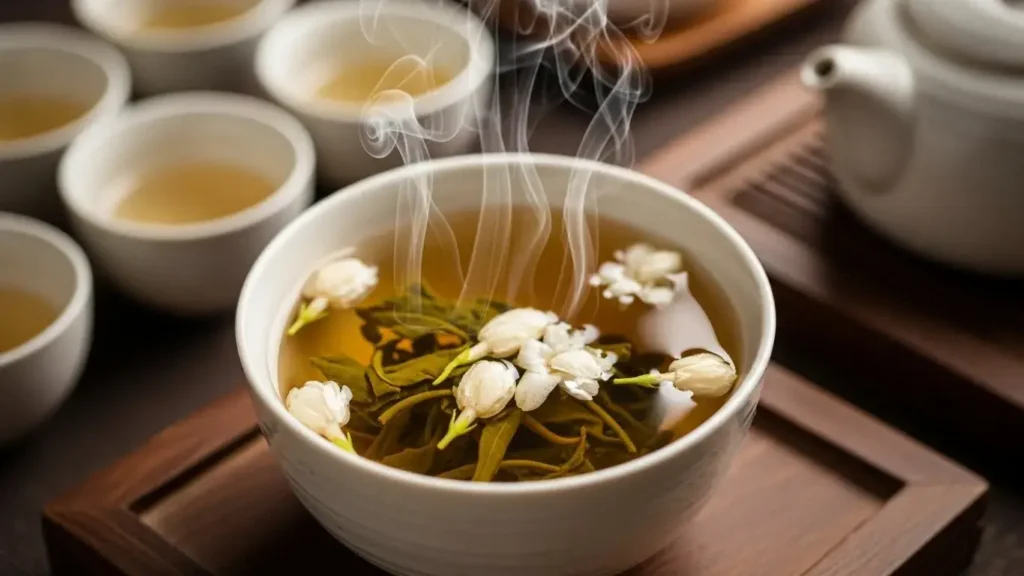
Jasmine Pearls: Also called Dragon Pearls, these premium teas feature young leaves and buds hand-rolled into tight balls. During the labor-intensive process, each pearl contains precisely measured leaves carefully shaped by skilled workers. As these pearls unfurl in hot water, they release waves of aroma and can be brewed multiple times—typically 2-3 infusions. This reusable quality makes pearls cost-effective despite their higher initial price.
Loose Leaf Jasmine: This everyday form consists of jasmine-scented tea leaves without special shaping. Quality varies widely, from everyday affordable options to premium grades with silver tips. Loose leaf jasmine tea typically undergoes fewer scenting cycles than pearls.
Tea Bags: Though convenient, bagged jasmine tea usually contains lower-quality “tea dust” that cannot undergo natural scenting processes effectively. These often rely on artificial flavoring rather than traditional scenting methods.
How scenting affects flavor and strength
The traditional scenting process fundamentally shapes jasmine tea’s character through a meticulous procedure:
Jasmine flowers are picked during daylight hours while closed
The flowers and tea are layered together as night falls
When jasmine blooms release their fragrance, tea leaves absorb these aromatic compounds
After scenting, spent flowers are removed and tea is dried
What truly distinguishes premium jasmine from ordinary varieties lies in the number of scenting cycles. Basic jasmine tea undergoes just 1-2 scenting processes, whereas competition-grade jasmine may experience nine or more scenting cycles—called Yìn. Each additional cycle layers more complexity and fragrance depth, requiring progressively higher quality tea bases to support this intensification.
According to experts, the number of scenting repetitions represents the single most important quality indicator for jasmine tea. High-grade jasmine pearls typically undergo at least five scenting cycles to achieve their distinctive aromatics. Consequently, tea masters adjust brewing parameters—particularly the jasmine tea to water ratio—based on scenting intensity to achieve balanced extraction.
Beyond understanding tea varieties, water serves as the fundamental element that can elevate or ruin your jasmine tea experience. Indeed, mastering the proper jasmine tea to water ratio begins with understanding water’s crucial role in the brewing process.
Why water quality matters
Water quality fundamentally impacts the flavor profile of jasmine tea. Not all water types yield equal results when brewing this delicate beverage. Spring water stands as the top choice for jasmine tea preparation, followed by filtered water as a suitable alternative. These options preserve the tea’s authentic taste without introducing unwanted elements.
I recommend avoiding both distilled and tap water when brewing jasmine tea. Distilled water lacks minerals that help develop flavors, essentially creating a flat-tasting cup. Furthermore, tap water often contains chlorine and other chemicals that can make jasmine tea taste noticeably bitter and mask its delicate floral notes.
Consider how water affects your tea experience:
Spring water: Enhances delicate flavors and maintains natural sweetness
Filtered water: Provides stable brewing environment with consistent results
Tap water: Introduces unwanted flavors and increases bitterness
Proper water quality ensures your jasmine tea maintains its signature delicate flavor profile and allows the natural sweetness to emerge unhindered.
Ideal water temperature for jasmine tea
Temperature control remains absolutely essential when brewing jasmine tea. Since most jasmine tea uses green tea as its base, it requires specific temperature ranges for optimal extraction.
The consensus among tea experts indicates that jasmine green tea should be brewed between 160-180°F (71-82°C). Some sources specify an even narrower ideal range of 175-185°F (80-85°C) for bringing out sweet floral notes without releasing excessive bitterness.
If you’re brewing jasmine tea with different bases, adjust your temperature accordingly:
White tea-based jasmine: 150-160°F (65-71°C)
Oolong-based jasmine: Up to 190°F (88°C)
Black tea-based jasmine: Full boiling water
Without a thermometer, you can still achieve proper temperature by bringing water to a boil, then letting it sit uncovered for 1-2 minutes before pouring. Alternatively, watch for “fish eye” bubbles that haven’t yet reached the water’s surface—this visual indicator typically signifies the 160-180°F range.
How to avoid bitterness with correct temp
Using water that’s too hot for jasmine tea effectively “burns” the leaves, releasing excessive tannins and catechins that create unpleasant bitterness. This destroys the delicate balance of flavors that makes jasmine tea so appealing.
Scientists explain that temperature primarily determines which compounds end up in your cup. High temperatures extract more bitter compounds, whereas proper temperatures selectively pull out sweet amino acids like L-theanine that contribute pleasant complexity.
I find that precise temperature control offers several benefits:
Preserves delicate floral aromas
Prevents bitterness and astringency
Maintains natural sweetness
Extracts beneficial compounds effectively
If you consistently experience bitter jasmine tea despite using quality leaves, examine your brewing temperature first. Reducing water temperature by just 5-10 degrees can dramatically improve flavor. Once you’ve mastered proper water temperature, you’ll discover an entirely new dimension to your jasmine tea experience.
Mastering the Jasmine Tea to Water Ratio
Precise measurements make all the difference when creating the perfect cup of jasmine tea. Finding the ideal jasmine tea to water ratio enables you to extract maximum flavor without unwanted bitterness.
Standard jasmine tea to water ratio grams
The industry standard for brewing jasmine tea follows a simple formula that professionals use consistently. For most jasmine teas, use 2-3 grams of tea per 8 ounces (240ml) of water. This baseline measurement works well for everyday brewing and creates a balanced cup with proper strength.
For those without a scale, this translates to approximately 1 teaspoon of loose leaf tea per 8-ounce cup. Obviously, this visual measurement varies slightly depending on the tea’s density and leaf size.
In more precise terms, some experts recommend using 2.5 grams of tea per 6 ounces (180ml) of water. This slightly stronger ratio brings out more intense flavors without crossing into bitterness territory.
Loose leaf jasmine tea to water ratio
Loose leaf jasmine tea requires room to expand as it steeps. When brewing Western-style (in a larger vessel), maintain the 1 teaspoon (2-3g) per 8 ounces (240ml) standard. This creates an accessible, everyday cup that most tea drinkers enjoy.
Correspondingly, pre-warming your vessel before adding tea helps maintain proper brewing temperature. This simple step prevents your carefully heated water from cooling too quickly upon contact with a cold teapot.
For gongfu-style brewing—a traditional Chinese method—the ratio changes dramatically. Use 5-7 grams of tea per 120ml (about 4 oz) of water. This higher concentration creates a more intense but nuanced flavor profile that evolves through multiple short infusions.
Jasmine green tea to water ratio for best flavor
Jasmine green tea specifically performs best when using 1 rounded teaspoon (approximately 2.5 grams) per 6 ounces of water. This slightly concentrated ratio perfectly balances the delicate green tea base with jasmine’s floral notes.
Notably, high-quality jasmine tea can be infused multiple times. Starting with a shorter steep preserves this potential and allows for several flavorful cups. Each subsequent infusion reveals different aspects of the tea’s character.
Adjusting ratio based on tea type and strength
Different jasmine tea forms require specific ratio adjustments:
For Jasmine Pearls: These tightly rolled balls of tea unfurl gradually. Use the same weight (2-3g per 8oz), even though visually it may appear to be less tea. Pearls typically need slightly longer initial steeping time—about 45-60 seconds—to begin opening properly.
For Western vs. Gongfu brewing: The brewing method fundamentally changes your approach:
Feature
Western-Style
Gongfu-Style
Vessel Size
Large (240ml+)
Small (100-150ml)
Leaf Ratio
Low (3g/240ml)
High (5-7g/120ml)
Steep Time
Long (2-4 min)
Short (15-45 sec)
Infusions
1-2
5-8+
Eventually, your personal taste preferences should guide adjustments. If you prefer stronger tea, slightly increase the amount of leaves rather than extending steep time, which can release unwanted bitterness.
In essence, finding your perfect jasmine tea to water ratio might require experimentation, but these guidelines provide a solid foundation for consistently excellent results.
Mastering brewing techniques ensures your jasmine tea to water ratio consistently delivers an excellent cup every time. Two principal methods offer distinctly different experiences, each highlighting unique aspects of jasmine tea’s character.
Western-style brewing method
The Western approach primarily focuses on convenience and simplicity. For this method, use 2-3 grams (approximately one teaspoon) of jasmine tea for every 8 ounces (240ml) of water. Pre-warm your teapot or mug with hot water before adding tea leaves to maintain proper temperature throughout brewing. Heat water to 160-180°F (71-82°C), then steep for 2-4 minutes depending on your desired strength. This method typically yields 1-2 full-flavored infusions.
Gongfu-style brewing for multiple infusions
Gongfu brewing (功夫茶) reveals jasmine tea’s complex flavor evolution through multiple short steepings. Use a small vessel (100-150ml) with a higher leaf-to-water ratio—about 6 grams per 120ml. First, perform a quick 5-second rinse to “wake up” the leaves, then discard this liquid. For subsequent infusions, begin with just 15-20 seconds, adding 5-10 seconds with each new steep. This method can yield 5-8 flavorful infusions from quality jasmine tea.
Tips for steeping time and temperature control
Steeping time directly correlates with strength and potential bitterness. For optimal results, start with shorter steeps (2 minutes for Western brewing) and taste every 30 seconds until finding your preference. The timing chart below offers guidance:
Steeping Time
Flavor Profile
Notes
1-2 minutes
Light, delicate
Gentler on system
2-3 minutes
Balanced, aromatic
Optimal extraction
3-4 minutes
Stronger, robust
Higher caffeine
Using a tea temperature chart for accuracy
Temperature precision prevents bitterness while maximizing flavor. Without a thermometer, watch water for “fish eye” bubbles that haven’t reached the surface—this visual indicator typically represents the ideal 160-180°F range. For different jasmine varieties, adjust accordingly:
Jasmine green tea: 175-185°F (80-85°C)
Jasmine white tea: 150-160°F (65-71°C)
Jasmine oolong: Up to 190°F (88°C)
Jasmine black tea: Full boil (212°F/100°C)
Ultimately, experimentation within these guidelines helps discover your perfect brewing parameters.
Common Mistakes and How to Fix Them
Even master tea brewers occasionally make mistakes. Recognizing common brewing errors serves as the first step toward achieving the perfect jasmine tea to water ratio every time.
Oversteeping and bitterness
Leaving tea to steep too long extracts excessive tannins, creating that unpleasantly bitter, astringent taste that overwhelms jasmine’s delicate floral notes. For balanced flavor, steep jasmine green tea for only 2-3 minutes. This timing extracts pleasant flavors while preventing bitter compounds from dominating your cup.
To fix bitter tea, don’t discard it. Adding a small amount of lemon juice reduces bitterness without sweetening. Alternatively, a touch of milk mellows the flavor by cutting through astringency. For gongfu brewing, simply reduce steeping time to 10-15 seconds for subsequent infusions.
Using boiling water on green tea
Possibly the most prevalent mistake is brewing jasmine tea with water that’s too hot. Boiling water (212°F/100°C) scorches delicate jasmine leaves, releasing bitter compounds and destroying floral notes. Instead, use water between 160-180°F (71-82°C).
Without a thermometer, allow boiling water to cool for 2-3 minutes before pouring. Watch for “fish eye” bubbles that haven’t yet reached the water’s surface as a visual temperature indicator.
Incorrect tea to water ratio
Either too much or too little tea creates an imbalanced cup. Insufficient leaves yield weak, flavorless tea lacking aroma. Conversely, excessive leaves can make tea overwhelmingly strong.
Follow the standard measurement of 1 teaspoon (2-3g) per 8oz (240ml) of water for Western-style brewing. For gongfu brewing, use 5-7g per 120ml. Remember that jasmine pearls unfurl during brewing, requiring slightly less initial volume.
Storing tea improperly
Proper storage preserves jasmine tea’s delicate aroma. Store in airtight, opaque containers away from light, heat, moisture, and strong odors. Light degrades tea quickly, while humidity encourages mold growth.
Avoid the “spice cabinet catastrophe”—keeping jasmine tea near strong-smelling items can permanently alter its flavor as tea readily absorbs surrounding odors. Finally, purchase reasonable quantities, as even properly stored jasmine tea gradually loses its distinctive floral qualities.
Mastering the perfect jasmine tea to water ratio transforms an ordinary cup into an extraordinary experience. Throughout this guide, we’ve explored the nuances that affect the quality of your jasmine brew – from water temperature to steeping times, tea types to brewing methods.
Water quality undoubtedly makes a significant difference in your final cup. Spring or filtered water heated to 160-180°F creates the ideal foundation for green-based jasmine tea, while other varieties require their own specific temperature ranges. This careful approach prevents bitterness while unlocking the delicate floral notes jasmine tea is celebrated for.
The standard ratio of 2-3 grams per 8 ounces works well for most situations, though adjustments based on your brewing method will elevate your experience further. Western-style brewing offers simplicity, whereas Gongfu-style unlocks multiple infusions with more concentrated ratios.
Remember, common mistakes such as oversteeping, using water that’s too hot, or incorrect ratios can easily ruin your tea experience. Proper storage also plays a crucial role in maintaining jasmine tea’s distinctive aroma and flavor profile over time.
After experimenting with these guidelines, you’ll discover your personal preferences and develop an intuitive understanding of how to brew the perfect cup. The journey to jasmine tea mastery continues with each brewing session as you refine your technique.
Your newfound knowledge about jasmine tea will certainly impress both yourself and anyone fortunate enough to share your perfectly brewed cup. Most importantly, the delicate balance of floral aroma and tea base flavors will provide a moment of tranquility in your busy day – all thanks to your attention to the perfect jasmine tea to water ratio.
Key Takeaways
Master the art of jasmine tea brewing with these essential insights that will transform your tea experience from ordinary to extraordinary.
Use 2-3 grams of jasmine tea per 8 ounces of water for the perfect balance of flavor and strength
Heat water to 160-180°F (71-82°C) for green-based jasmine tea to prevent bitterness and preserve delicate floral notes
Steep for 2-3 minutes maximum to extract optimal flavors without releasing harsh tannins
Choose spring or filtered water over tap water to avoid chlorine interference with jasmine’s subtle aromatics
Store jasmine tea in airtight, opaque containers away from light and strong odors to preserve its distinctive fragrance
The key to exceptional jasmine tea lies in precision and patience. Quality jasmine tea undergoes multiple scenting cycles with fresh jasmine flowers, creating layers of complexity that require careful extraction. Whether you prefer Western-style brewing for convenience or Gongfu-style for multiple infusions, these fundamental ratios and techniques will consistently deliver that perfect cup with balanced floral sweetness and no unwanted bitterness.
Q1. What is the ideal jasmine tea to water ratio? For most jasmine teas, use 2-3 grams of tea per 8 ounces (240ml) of water. This ratio creates a balanced cup with proper strength. Adjust slightly based on personal preference and tea type.
Q2. What’s the best water temperature for brewing jasmine tea? The ideal water temperature for jasmine tea is between 160-180°F (71-82°C). This range helps extract optimal flavors without releasing bitterness. For green-based jasmine teas, aim for 175-185°F (80-85°C).
Q3. How long should I steep jasmine tea? Steep jasmine tea for 2-3 minutes for the best flavor. Steeping too long can result in bitterness. If you prefer a stronger brew, add more tea leaves rather than extending the steeping time.
Q4. Can I reuse jasmine tea leaves for multiple infusions? Yes, quality jasmine tea leaves can be reused for multiple infusions. Start with a shorter steep time for the first infusion, then gradually increase the time for subsequent brews. This method can yield 5-8 flavorful cups from the same leaves.
Q5. How should I store jasmine tea to preserve its flavor? Store jasmine tea in an airtight, opaque container away from light, heat, moisture, and strong odors. This helps preserve the tea’s delicate floral aroma and flavor. Avoid storing it near strong-smelling items, as tea readily absorbs surrounding odors.
Black Tea Extract that is rich in natural theaflavins and polyphenols that help protect your body from free radicals, promoting overall immune health and well-being
Contains blended amounts of Fruits and Veggies. All natural, with whole foods, fruit and vegetable supplement.Perfect for everyone looking to live a healthier lifestyle.