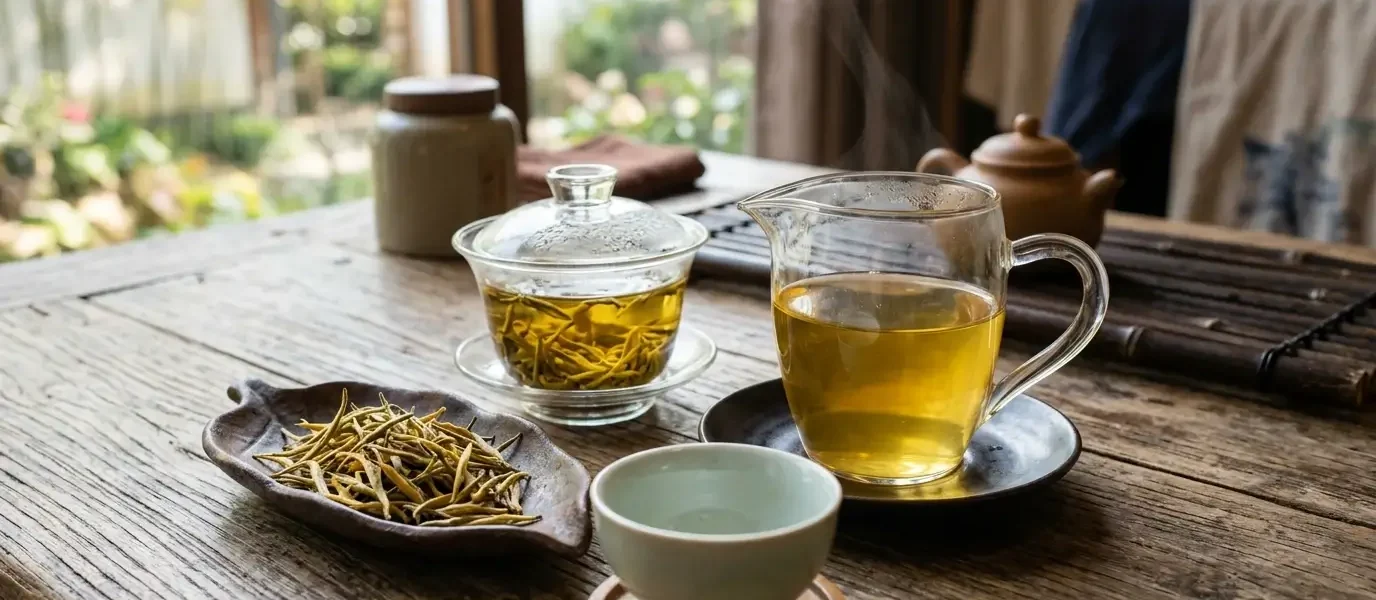
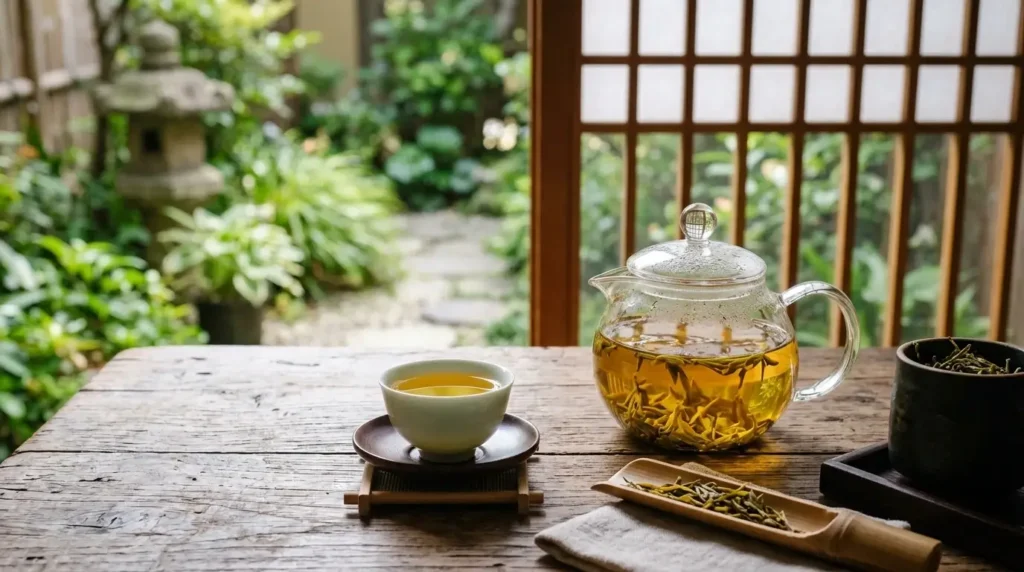
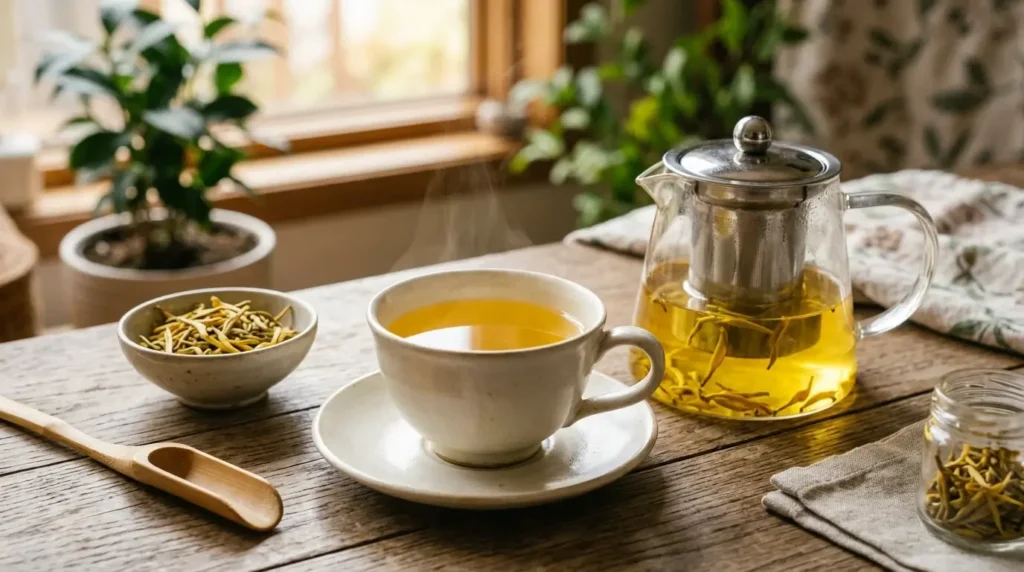
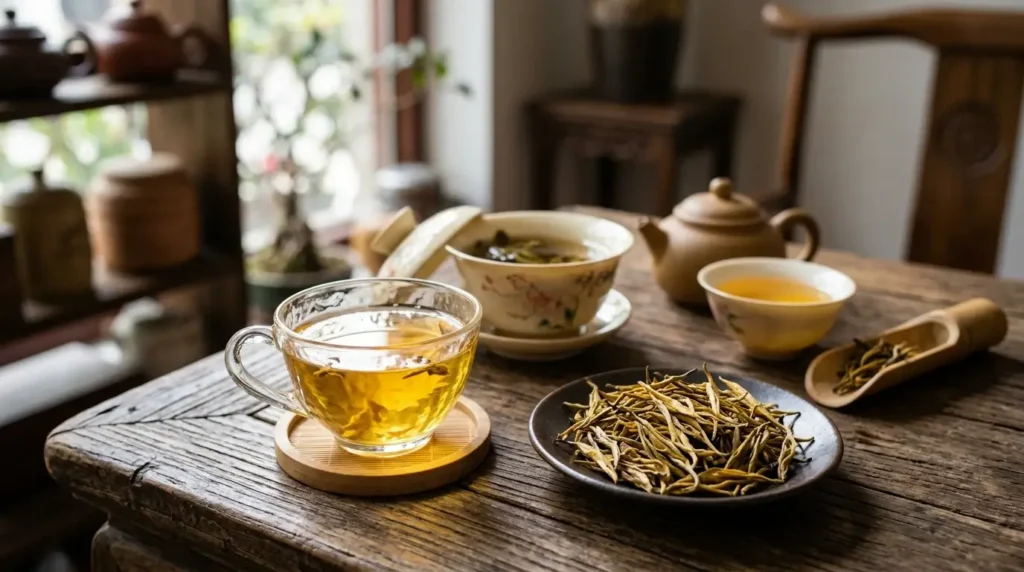
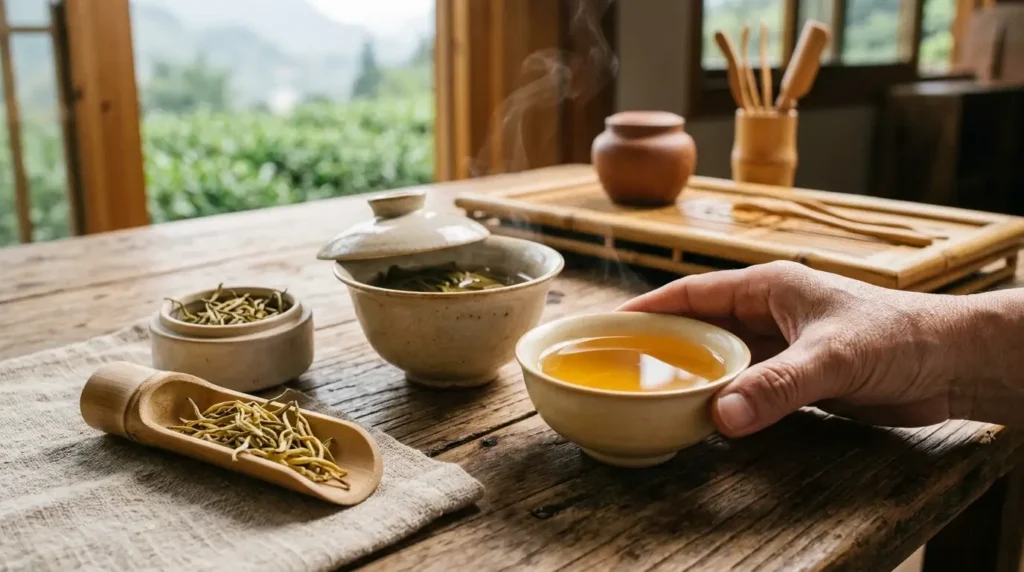
You’ve probably heard of green tea, black tea, and even white tea, but you might wonder, yellow tea what is it? This rare Chinese tea is one of the most elusive beverages in the tea world. In fact, there are only three main types of yellow tea available on the market today. What makes this tea so special is its unique production process, particularly the “sweltering” step that removes the grassy bite found in typical green tea while giving the leaves a distinctive yellow hue.
Because the yellowing process requires precise control of humidity and temperature over nearly three days, many farmers have abandoned it in favor of easier teas. In this guide, I’ll walk you through what yellow tea is, how it’s made, where to find it, and how to brew it perfectly.
Key Takeaways
Yellow tea is one of the world’s rarest beverages, representing only 1% of global tea production due to its complex three-day manufacturing process that few tea masters still know how to execute properly.
• Yellow tea undergoes a unique “Men Huang” yellowing process where leaves are wrapped and sweltered for hours to days, creating a smoother, less grassy flavor than green tea.
• Only four authentic varieties exist, grown in specific Chinese provinces: Junshan Yinzhen, Meng Ding Huang Ya, Huoshan Huang Ya, and Mo Gan Huang Ya.
• Brew yellow tea at 167-185°F for 2-3 minutes to unlock its distinctive nutty, sweet flavor profile with honeydew and floral notes.
• The labor-intensive production requiring precise humidity and temperature control has led most farmers to abandon yellow tea for easier-to-produce green teas.
• Yellow tea offers a unique middle ground between green and black tea, with moderate caffeine content (20-64mg per cup) and the ability to be steeped multiple times.
This rare tea represents centuries of Chinese tea craftsmanship and offers tea enthusiasts a truly distinctive tasting experience that bridges the gap between familiar tea categories.
What Is Yellow Tea and Why Is It So Rare
The Definition of Yellow Tea
Chinese yellow tea, or huángchá, is a lightly oxidized tea that occupies a unique space in the tea spectrum. While it sits somewhere between green and dark tea, the processing closely resembles green tea with one critical difference: an additional sweltering step. This step transforms the leaves from green to yellow and fundamentally alters the flavor profile.
The term itself refers to the distinctive yellowish-green hue of both the dry leaves and the brewed infusion. This color comes from transformations of the leaf chlorophyll during processing. One of the primary goals behind creating yellow tea was to eliminate the characteristic grassy smell found in green tea while preserving its health benefits. The result is a tea that tastes sweet, fresh, and nutty with gentle floral notes.
The Unique ‘Men Huang’ Yellowing Process
Men Huang, which literally translates to “turning yellow” or “sealing yellow,” is the soul of yellow tea production. After the kill-green step halts oxidation, the warm and damp tea leaves are enclosed in a breathable material like cloth or paper. The leaves are then sweltered for 6-8 hours at temperatures close to human body temperature.
During this controlled environment, amino acids and polyphenols in the processed leaves undergo chemical changes that give yellow tea its distinct briskness and mellow taste. This is non-enzymatic oxidation, fundamentally different from the enzymatic oxidation that occurs in oolong or black tea. The yellowing duration varies dramatically depending on the variety. Some teas undergo Men Huang for just 30 minutes, while others require up to six days.
Why Yellow Tea Is Hard to Find
Yellow tea represents only 1% of the world’s tea production. The rarity stems from multiple factors, starting with the production timeline. The process takes up to three days to complete, requiring constant monitoring of humidity and temperature. If wrapped too long, the leaves spoil. Too short, and the flavor remains indistinguishable from cheap green tea.
Only a handful of tea masters in China still retain the knowledge to produce this imperial tea. The exact manufacturing method was kept secret by the imperial court for centuries, limiting its spread. In addition, yellow tea production is concentrated in specific provinces—Hunan, Anhui, Sichuan, and Zhejiang—where the right climate and soil conditions exist. Given the labor intensity, low yield, and high risk of failure, most farmers have abandoned yellow tea in favor of faster-selling green teas.
How Yellow Tea Is Made: The Production Process
Harvesting the Tea Leaves
Production begins with meticulous hand-picking during early spring, usually in March when buds reach their optimal growing phase. High-quality yellow tea demands only the youngest, most tender buds, often harvested before they develop their characteristic downy fuzz. For premium varieties like Meng Ding Huang Ya, pickers select buds grown at elevations between 700 and 1,400 meters, where cloud and mist conditions concentrate sweetness. Experienced harvesters choose only the bud itself, or occasionally the bud with one delicate leaf.
Withering and Kill-Green (Fixation)
Once harvested, the leaves undergo controlled withering outdoors in shaded areas to lose approximately 5% of their moisture content. This brief phase softens the leaves without triggering oxidation. Subsequently, the withered leaves move to the fixation stage, where they’re pan-fired using the traditional Chinese sha qing method. Workers heat large woks to around 150 degrees Fahrenheit, manually tossing and pressing the leaves to deactivate oxidizing enzymes. This kill-green step preserves the natural leaf compounds while setting up the chemistry for yellowing.
The Yellowing Step (Men Huang)
After fixation, the still-warm leaves are wrapped in cloth or specialized “Cow Skin Paper” and piled into thick packets. These packets undergo alternating cycles of wrapping and pan-frying, repeated several times over the production period. The packets are shifted repeatedly and sometimes moistened or heated with steam to maintain uniform conditions. This cyclical process can extend from several hours to multiple days depending on the desired flavor complexity.
Final Drying and Sorting
The final drying occurs at gentle temperatures around 50 degrees Celsius to reduce moisture content to no more than 5%. Producers carefully balance temperature and time to preserve the delicate aromas developed during yellowing. The dried leaves then undergo a grading process where workers sort them by size, shape, and quality, removing imperfect specimens.
Only a handful of authentic yellow tea varieties exist, each tied to specific mountain regions in China where conditions allow this delicate tea to thrive.
Junshan Yinzhen (Silver Needle)
Junshan Yinzhen comes from Junshan Island, a tiny landmass measuring just 0.96 square kilometers in Hunan Province’s Dongting Lake. This bud-only tea holds the distinction of being the rarest yellow tea in China, with most of the annual harvest reserved for government departments and visiting diplomats. The island’s state-owned status and extremely limited production area contribute to its scarcity. Allegedly the preferred tea of Chairman Mao Zedong, Junshan Yinzhen undergoes harvest in late March, when workers select only unopened buds approximately 3cm tall. The tea processing requires at least 72 hours to complete using traditional yellow tea methods.
Meng Ding Huang Ya
Meng Ding Huang Ya originates from Mengding Mountain in Sichuan Province’s Ya’an region, where tea cultivation dates back to 53BC. This area holds the documented distinction of being the first unambiguous written record of tea cultivation. The tea grows at elevations ranging from 700 to 1,400 meters above sea level, where year-round cloud and mist conditions concentrate sweetness into each leaf. Meng Ding Huang Ya served as an imperial tribute tea from the Tang Dynasty through the Qing Dynasty. Harvest occurs in early March, with only the smallest, youngest buds picked when fully covered in soft downy fuzz.
Huoshan Huang Ya
Huoshan Huang Ya grows in Huoshan County within Anhui Province’s Dabie Mountains. This tea carries a unique history: production stopped towards the end of the Qing Dynasty in the late 1800s, with the technique completely lost. Local makers recreated Huoshan Huang Ya in 1973 with help from tea scientists. The tea’s most significant characteristic is its strong chestnut flavor. Harvest occurs after April 5th, with higher elevations picked even later.
Mo Gan Huang Ya
Mo Gan Huang Ya comes from Mount Mogan in Zhejiang Province’s Deqing County, Huzhou City. Tea master Wang Xiangzhen, honored as Master of Intangible Cultural Heritage by the state, produces this tea along with her daughter and granddaughter, creating a rare three-generation lineage of women tea makers. The tea grows above 700 meters elevation, with harvest occurring around late April. The high altitude causes slower growth compared to lower regions.
How to Brew Yellow Tea and What It Tastes Like
Flavor Profile: What to Expect
Yellow tea delivers a smoother, less earthy taste than green tea without the dark, roasty notes found in black teas. The slight oxidation creates hints of toasted grain, sweet corn, and subtle nuttiness with clean sugar-cane sweetness. You’ll notice honeydew melon notes, summer meadow florals, and a buttery texture that lingers. The aroma carries a slightly malty quality resembling crispy rice.
Water Temperature and Steeping Time
Heat water to 167-185°F. Boiling water damages the delicate leaves and draws out bitterness. Preheat your ceramic or glass vessel by swirling hot water inside before brewing. Use one teaspoon of loose leaves per cup and steep for 2-3 minutes.
Tips for Multiple Infusions
Yellow tea leaves withstand 3-12 infusions. Increase steeping time by 30 seconds to one minute for each subsequent brew. Later infusions reveal more intense, complex flavors as the leaves fully unfurl. The second infusion often produces the sweetest cup.
Yellow Tea Caffeine Content
Caffeine content varies between sources. One study found 3.18% caffeine content, yielding approximately 64mg per 2-gram serving. Other estimates range from 20-30mg per cup to 40-50mg, positioning yellow tea between green and black tea in caffeine strength.
Yellow tea remains one of the tea world’s best-kept secrets due to its demanding production process and limited availability. Now that you understand what makes it special, you can appreciate why this tea commands premium prices and devoted followings.
If you get the chance to try authentic yellow tea, don’t hesitate. The smooth, nutty flavor profile offers a unique experience you won’t find in any other tea category. Just remember to brew it at the right temperature to unlock its full potential.
FAQs
Q1. What exactly is yellow tea and how is it different from green tea? Yellow tea is a lightly oxidized Chinese tea that closely resembles green tea but includes an additional “men huang” (yellowing) step in its production. After the kill-green process that stops oxidation, the warm leaves are wrapped in cloth or paper and allowed to undergo controlled non-enzymatic oxidation for several hours to days. This unique step gives the leaves their distinctive yellowish color and creates a smoother, sweeter flavor profile while eliminating the grassy bitterness typically found in green tea.
Q2. Why is yellow tea so rare and hard to find? Yellow tea represents only 1% of global tea production due to its extremely labor-intensive and time-sensitive production process. The yellowing step requires precise control of humidity and temperature over up to three days, with constant monitoring to prevent spoilage. Only a handful of tea masters in China still possess the knowledge to produce it correctly, and the technique was kept secret by the imperial court for centuries. Most farmers have abandoned yellow tea production in favor of easier, faster-selling green teas.
Q3. What does yellow tea taste like? Yellow tea offers a smooth, mellow flavor profile with sweet, nutty, and gentle floral notes. You can expect hints of toasted grain, sweet corn, honeydew melon, and summer meadow florals with a buttery texture and clean sugar-cane sweetness. The aroma carries a slightly malty quality resembling crispy rice. Unlike green tea, it lacks grassiness and bitterness, while avoiding the dark, roasty notes found in black teas.
Q4. What is the best way to brew yellow tea? Heat water to 167-185°F (avoid boiling water, which damages the delicate leaves and creates bitterness). Use one teaspoon of loose leaves per cup and steep for 2-3 minutes. Preheat your ceramic or glass vessel before brewing. Yellow tea leaves can be re-steeped 3-12 times—increase steeping time by 30 seconds to one minute for each subsequent infusion, with the second infusion often producing the sweetest cup.
Q5. How much caffeine does yellow tea contain? Yellow tea’s caffeine content falls between green and black tea, with estimates ranging from 20-50mg per cup depending on the variety and brewing method. One study found approximately 64mg per 2-gram serving. This moderate caffeine level makes it a good middle-ground option for those seeking more energy than green tea provides but less stimulation than black tea.
Black Tea Extract that is rich in natural theaflavins and polyphenols that help protect your body from free radicals, promoting overall immune health and well-being
Contains blended amounts of Fruits and Veggies. All natural, with whole foods, fruit and vegetable supplement.Perfect for everyone looking to live a healthier lifestyle.