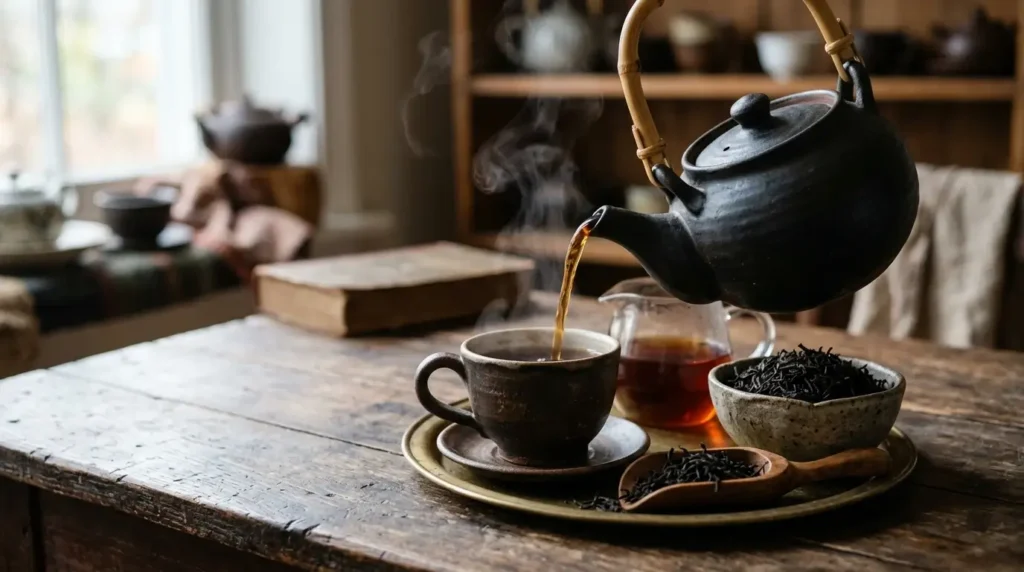
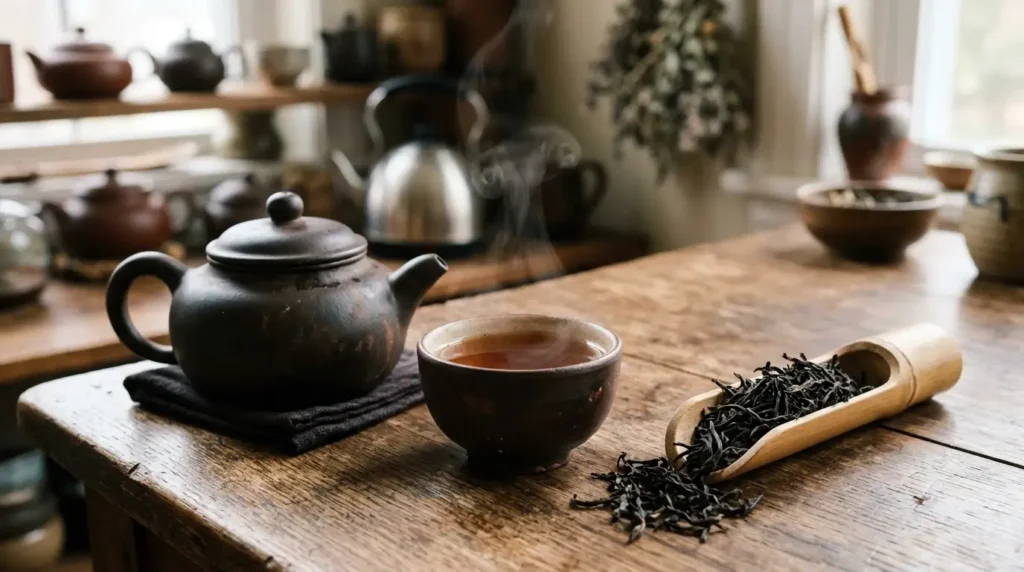
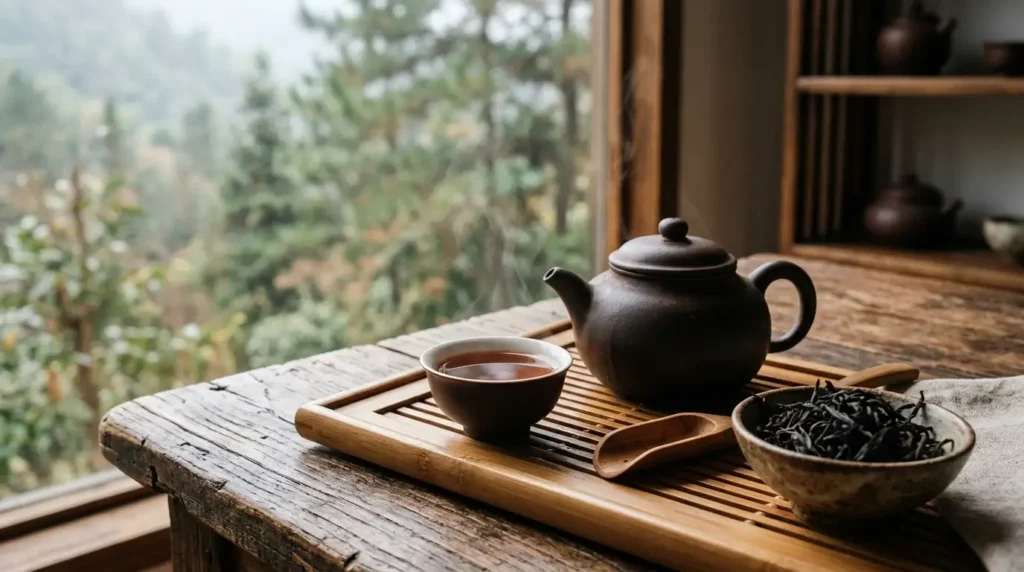
Few teas in the world announce themselves as boldly as Lapsang Souchong. Before you even lift the cup, the aroma finds you — rich, smoky, and unmistakably ancient. But behind that distinctive perfume lies one of the most fascinating stories in the entire history of tea. To truly understand this remarkable brew, you need to understand lapsang souchong tea in Chinese — its name, its roots, and the mountain culture that gave birth to it centuries ago.
This is not just another black tea. It is considered the world’s first black tea, a brew that reshaped global trade, influenced British afternoon tea culture, and sparked the creation of teas as famous as Earl Grey and Keemun. Yet despite its enormous global legacy, it remains deeply rooted in the misty peaks of Fujian Province, China — where pine trees still grow thick and tea farmers still practice the ancient art of smoke-drying by hand.
In this guide, we’ll explore what makes lapsang souchong truly unique — from its Chinese name and legendary origins, to its complex flavor profile, health benefits, and the best ways to brew it. Whether you’re a seasoned tea drinker or a curious newcomer, this deep dive will transform the way you experience every smoky sip.
What Is Lapsang Souchong Tea? The Chinese Name and Its Meaning
To understand this tea, you must first understand its name — because the name itself tells the story of its identity.
The Chinese Name: 正山小種 (Zhèngshān Xiǎozhǒng)
In Mandarin Chinese, lapsang souchong is written as 正山小種 and pronounced zhèngshān xiǎozhǒng. The name breaks down beautifully:
正山 (Zhèngshān) — “Proper Mountain” or “Authentic Mountain,” referring specifically to the Wuyi Mountain area of Fujian Province
小種 (Xiǎozhǒng) — “Small Varietal” or “Small Sort,” referring to the smaller leaf variety of the Camellia sinensis plant used in its production
Together, the name translates roughly as “Proper Mountain Small Varietal” — a name that immediately signals geographic authenticity. If the tea doesn’t come from Zhengshan (the true Wuyi Mountain heartland), purists argue it simply isn’t genuine lapsang souchong.
What “Lapsang Souchong” Means in the Fuzhou Dialect
The Western trade name “lapsang souchong” comes from the Fuzhou dialect of Chinese, not Mandarin. In Fuzhou:
Lapsang (立山 or 拉山) — derived from words meaning “pine” and “wood,” reflecting the essential role of pinewood in the smoking process
Souchong (小種) — means “small sort” or “sub-variety,” a reference to the leaf grade
So in essence, the Western name lapsang souchong and the Mandarin name Zhengshan Xiaozhong both describe the same tea from slightly different angles — one emphasizing the smoking method, the other emphasizing the authentic mountain origin. Both names are correct. Both are meaningful.
Why the Name Matters for Authenticity
In China, there is an important distinction between 正山小種 (Zhengshan Xiaozhong) — authentic mountain lapsang from Tongmu Village in the Wuyi Mountains — and 外山小種 (Waishan Xiaozhong), which refers to teas produced outside this protected region using similar smoking methods. The prefix 正山 (authentic mountain) is essentially a geographic designation of quality and origin. Only tea from the Tongmu Village area can truly claim the full heritage of this ancient brew.
The Origins of Lapsang Souchong — A Tea Born from Legend
The story of how lapsang souchong came to be is as smoky and dramatic as the tea itself. History and legend intertwine in ways that make the truth all the more compelling.
The Wuyi Mountains: Birthplace of the World’s First Black Tea
The Wuyi Mountains of Fujian Province are among the most storied tea-producing landscapes on earth. Shrouded in mist, laced with mineral-rich soil, and blanketed by ancient forests of pine and bamboo, this UNESCO World Heritage region has cultivated extraordinary teas for centuries. Its high elevation and humid climate create ideal growing conditions for slow-developing leaves packed with complex flavor compounds.
Lapsang souchong is widely considered the world’s first black tea — predating Keemun, Assam, and Ceylon by centuries. All other black teas trace their lineage back to the techniques pioneered in Tongmu Village, deep within the Wuyi Mountain nature reserve.
The Legend of Soldiers and Accidental Smoke-Drying
Multiple origin legends exist for lapsang souchong, and all of them share a dramatic common thread: conflict, accident, and unexpected triumph.
The most widely told version dates the tea’s creation to approximately 1646, during the turbulent transition from the Ming to Qing dynasty. As Qing soldiers advanced through the Wuyi Mountain region, local tea farmers were forced to flee, abandoning freshly picked tea leaves in their processing sheds. When the soldiers camped overnight and used the bags of tea leaves as bedding, the leaves oxidized into a reddish-brown color — something that had never happened before to the green teas of the region.
When the farmers returned and found their crop seemingly ruined, they made a desperate decision: rather than discard the leaves, they dried them rapidly over fires fueled by the abundant local pine trees. The resinous pine wood, rich in aromatic compounds, infused the tea with an intense, smoky fragrance. The farmers expected to sell the tea at a loss — but when Dutch traders encountered it at market, they were captivated. They placed orders. They kept coming back.
A second legend ties the accidental creation to the Taiping Rebellion (1850–1864), when soldiers again disrupted tea production in the region, forcing farmers to use pinewood fires to salvage oxidized leaves. Whether the tea was first created in the 17th or 19th century, the essence of the story is the same: crisis became creativity, and a perceived disaster became a global commodity.
How Dutch and European Traders Spread It to the World
Records indicate that by approximately 1604, lapsang souchong was already being exported to Europe via Dutch merchants. The Dutch East India Company first purchased Wuyi black tea from Macau around 1607, re-exporting it to Europe through Java. At a time when the European market was dominated by Japanese green teas, this bold, oxidized black tea with its fierce smoky character was a revelation.
Crucially, the heavily oxidized leaves survived the months-long sea voyages from China to Europe far better than the delicate green varieties, which were prone to mold in the damp ship holds. Lapsang souchong’s robust nature made it the ideal global traveler — and it became one of the first Chinese teas to establish a lasting presence in European markets.
By 1662, when Portuguese princess Catherine of Braganza married King Charles II of England, she reportedly brought chests of Chinese black tea — believed to include lapsang souchong — as part of her royal dowry, helping to establish tea-drinking as a fashionable practice among British aristocracy.
What truly sets lapsang souchong apart from every other tea on earth is not where it grows, but how it is made. The production process is an art form passed down through generations of Fujian tea masters.
Hand-Picking the Right Leaves
Authentic lapsang souchong uses the fourth and fifth leaves of the Camellia sinensis plant — the broader, more mature leaves that sit further down the branch from the prized bud. These “souchong” grade leaves are considered less premium for unsmoked teas, but they hold the smoky treatment particularly well, developing a deep, full-bodied character that smaller leaves cannot achieve.
Harvesting is done by hand in the spring and occasionally in summer, with Tongmu Village’s small, high-altitude tea gardens producing only a limited annual supply. This scarcity is one reason why authentic 正山小種 commands premium prices.
Withering and Oxidation Over Pine Fires
Once picked, the leaves undergo a careful withering process. Unlike most teas where withering happens through exposure to air alone, lapsang souchong leaves are traditionally withered over gentle pine-wood fires in specially designed wooden smoking sheds. The pine smoke begins its work at this early stage, subtly infusing the leaves as they lose moisture and begin to soften.
After withering, the leaves are pan-fried briefly to halt oxidation at just the right moment, then carefully rolled by hand — a step that shapes the leaf and releases internal juices to enhance flavor development.
The Pine-Smoke Roasting in Bamboo Baskets
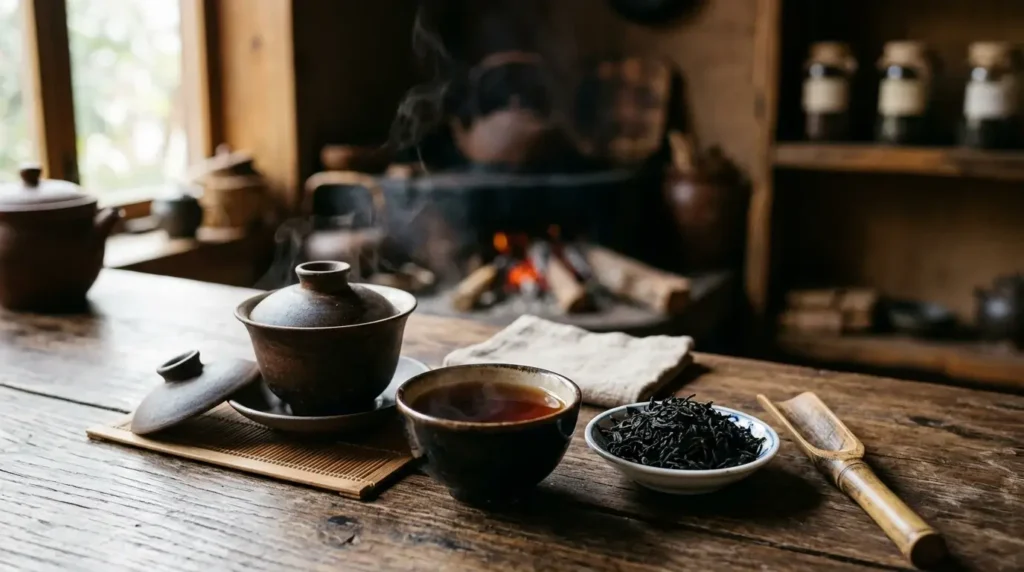
The defining step — the one that makes lapsang souchong entirely unlike any other tea — is the final smoke-roasting. The rolled leaves are placed into bamboo baskets called honglong, which are suspended on racks above smoldering Masson pine fires.
Masson pine (Pinus massoniana), native to the Wuyi Mountain region, produces a particularly resinous smoke rich in aromatic compounds — most notably longifolene and α-terpineol — that exist only in pine smoke and are found in no other type of tea. The duration and intensity of the smoking process can be varied: longer exposure creates a more intense, campfire-like character, while a lighter smoke produces a subtler, fruit-forward profile.
The result is a tea leaf that is dark, oily in appearance, and absolutely saturated with the essence of pine forest and open fire.
The Taste Profile — What Does Lapsang Souchong Actually Taste Like?
Lapsang souchong is one of the most divisive beverages in the world of tea. Some people smell it across the room and immediately fall in love. Others find it overwhelming. Almost no one is indifferent.
Smoky, Resinous, and Full-Bodied
The aroma of dry lapsang souchong leaves is often described as reminiscent of smoked bacon or a campfire — intensely empyreumatic (that is, having a charred, smoky quality). Once brewed, the liquor ranges from deep amber to dark mahogany in color, and the aroma softens slightly into something more nuanced and complex.
On the palate, lapsang souchong is:
Full-bodied with a smooth, rounded mouthfeel
Smoky with notes of pine resin, campfire, and smoked paprika
Subtly sweet, with undertones of dried longan fruit in premium grades
Non-bitter — unlike many black teas, it doesn’t require sweetening
Long-finishing, with a lingering smokiness that stays pleasantly on the palate
Notes of Dried Longan, Pine Resin, and Campfire
High-grade Zhengshan Xiaozhong from Tongmu Village is especially prized for its dried longan (龙眼, lóng yǎn) character — a sweet, slightly floral fruitiness that balances the smoke and gives the tea a warmth and depth that lower-grade smoked teas simply cannot match. This longan note emerges most strongly in the first two or three brews and gradually gives way to a deeper, more resinous character.
Connoisseurs often compare the experience of drinking fine lapsang souchong to enjoying a peated Scotch whisky or a fine cigar — layered, complex, and deeply satisfying for those who appreciate bold, aromatic experiences.
How It Differs from Other Chinese Black Teas
Tea
Region
Flavor Profile
Unique Feature
Lapsang Souchong
Wuyi Mountains, Fujian
Smoky, pine, longan, full-bodied
Pine-smoke dried; world’s first black tea
Keemun (Qimen)
Qimen, Anhui
Floral, wine-like, malty
The “Burgundy of teas”; developed from lapsang techniques
Yunnan (Dian Hong)
Yunnan Province
Malty, cocoa, honey
Golden-tipped leaves; known for sweetness
Jin Jun Mei
Tongmu Village, Fujian
Fruity, floral, delicate
All-bud tea; modern creation from same village
Lapsang Souchong in Chinese Culture vs. Global Popularity
Here lies one of the great ironies of lapsang souchong’s story: the tea that changed global history is far more celebrated outside China than within it.
An Export Tea — More Beloved Abroad Than at Home
For most of its history, lapsang souchong was produced in China primarily for export to Europe and America. The smoky, heavily oxidized profile that Westerners found so captivating was simply not aligned with the Chinese domestic preference for lighter, more delicate teas — green teas, white teas, and subtle oolongs. Chinese tea culture has traditionally valued freshness, floral fragrance, and subtlety; the bold smokiness of lapsang was considered a foreign taste, almost literally manufactured for foreign palates.
This does not mean the tea was unvalued in China — quite the opposite. It was considered a prestigious export and a symbol of Fujian’s tea-making heritage. But it was rarely drunk as an everyday cup within Chinese households the way it might be enjoyed in England or Russia.
Role in Russian Caravan Blends and British Afternoon Tea
Lapsang souchong played a foundational role in two of the world’s most famous tea traditions. In Russian Caravan blends, lapsang was historically added to impart a campfire smokiness that supposedly echoed the long camel caravan routes along which Chinese tea was transported overland to Russia. The smoky character was said to come from fires lit along the journey — though lapsang souchong gave blenders a reliable way to recreate that rugged, adventurous aroma.
In Britain, the introduction of lapsang souchong contributed to the broader establishment of black tea as the drink of choice for high society. When Queen Anne of Great Britain began advocating tea over ale as the court beverage of choice, Chinese black teas — including lapsang souchong — were among the fashionable imports that defined refined taste. The tradition of afternoon tea that developed from this aristocratic habit remains a cornerstone of British culture to this day.
The Unsmoked Zhengshan Xiaozhong and the Modern Revival
In an interesting twist, the early 21st century saw the development of an unsmoked variety of lapsang souchong in Tongmu Village. This tea, produced from the same high-mountain Camellia sinensis Bohea bushes but without the pine-smoking process, has become increasingly popular in the Chinese domestic market. It offers the terroir-driven sweetness and mineral complexity of the Wuyi Mountains without the smoke — a bridge between the ancient tradition and modern Chinese palates.
Meanwhile, the smoked version is experiencing a global renaissance, with specialty tea buyers increasingly seeking out authentic, small-batch Zhengshan Xiaozhong from Tongmu Village — and paying premium prices for the real thing.
Health Benefits of Lapsang Souchong in Chinese Tradition
Like all teas made from Camellia sinensis, lapsang souchong carries a range of health-supporting properties. While it was not traditionally classified as a medicinal herb in classical Chinese medicine the way some teas were, its robust black tea base provides meaningful wellness benefits.
Antioxidants and Anti-Inflammatory Properties
Lapsang souchong is rich in polyphenols — particularly theaflavins and thearubigins — the antioxidant compounds that form during the oxidation process of black tea production. These compounds help neutralize free radicals in the body, supporting cellular health and reducing oxidative stress. Research on black tea polyphenols suggests potential benefits for cardiovascular health, including support for healthy cholesterol levels and blood pressure.
The tea also contains natural anti-inflammatory compounds that may help soothe symptoms of mild inflammation. While no tea should be considered a substitute for medical treatment, incorporating antioxidant-rich beverages like lapsang souchong into a balanced diet is consistent with the broader principles of Chinese dietary wellness.
Digestive Support and Energy Boost
In traditional Chinese wellness philosophy, warm beverages — especially teas — are considered beneficial for digestive health. Lapsang souchong, like other black teas, has been associated with supporting healthy gut bacteria and soothing digestive discomfort. Its moderate caffeine content — roughly half that of a standard cup of coffee — provides a gentle, sustained energy lift without the sharp spike and crash associated with higher-caffeine drinks.
This makes it an excellent morning tea for those who want alertness and focus without overstimulation, or an afternoon companion for those who need a gentle pick-me-up.
Traditional Chinese Wellness Perspective
In the framework of Traditional Chinese Medicine (TCM), black teas are generally considered warming in nature — suitable for nourishing the body’s yang energy and supporting digestive fire. Lapsang souchong’s deeply warming character makes it particularly well-suited for cold weather consumption, aligning with the TCM principle of matching foods and beverages to seasons and constitutional needs.
The Lapsangstore historical records note that traditional Chinese writings spoke of the tea having a “prolonging life” quality — a reference to its general health-supporting properties that, while not scientifically validated in modern terms, reflects centuries of cultural esteem for the tea’s nourishing qualities.
How to Brew Lapsang Souchong the Authentic Chinese Way
To truly honor this tea, it’s worth learning how to brew it properly. The right technique unlocks the full complexity of the leaves and reveals the nuanced sweetness that lies beneath the smoke.
Water Temperature and Tea-to-Water Ratio
Lapsang souchong is a black tea and benefits from fully boiling water:
Water temperature: 100°C / 212°F (full boil)
Tea amount: 1 teaspoon (approximately 3g) per 180–200ml (6 oz) of water
Steep time: 3–4 minutes for a Western-style brew; 20–30 seconds per infusion for gongfu style
Multiple infusions: High-quality Zhengshan Xiaozhong can be re-steeped 5–7 times, with the character evolving beautifully with each infusion
Important note: Do not over-steep. Beyond 5 minutes, even lapsang souchong — which is naturally less bitter than many black teas — can develop an astringent edge that masks its natural sweetness.
Gongfu-Style vs. Western-Style Brewing
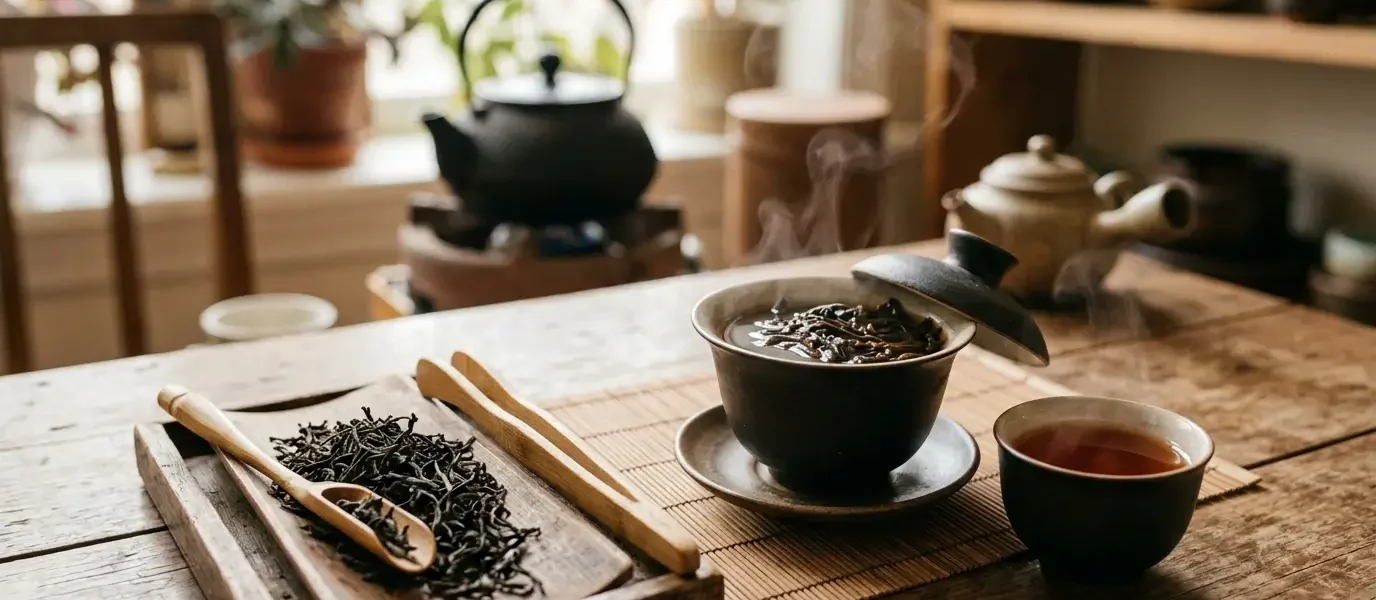
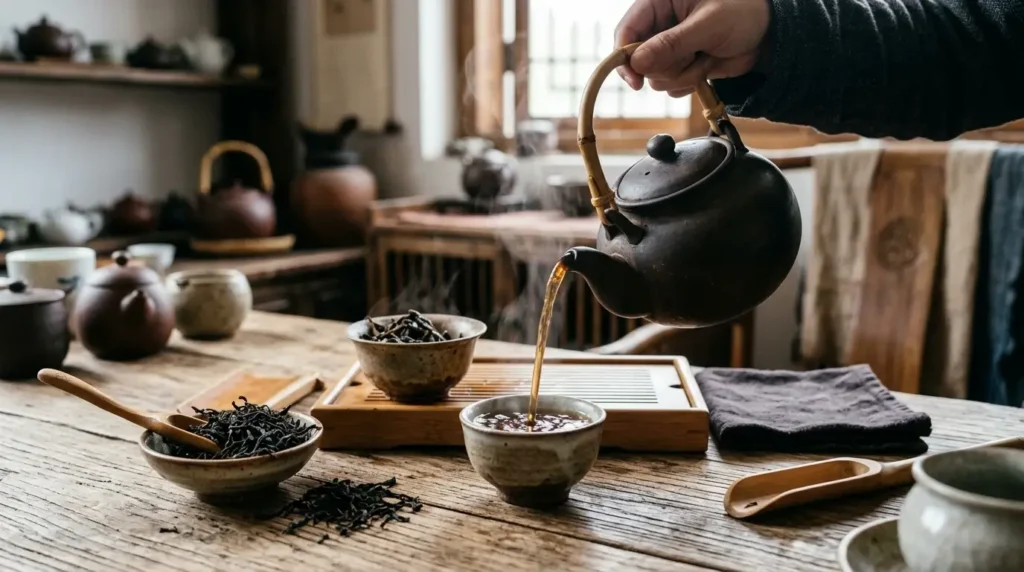
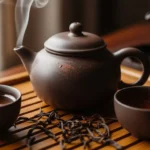
The gongfu (功夫茶) method — China’s traditional approach to fine tea — is the most rewarding way to experience authentic Zhengshan Xiaozhong. Using a small Yixing clay teapot or a gaiwan (covered bowl), you use a higher leaf-to-water ratio and very short infusion times, allowing the tea to reveal itself layer by layer across many steepings.
The progression is remarkable: early infusions tend to be sweeter and more fruit-forward, with the longan character prominent. Middle infusions bring out the full smoky depth. Later infusions become gentler, showing the tea’s mineral backbone.
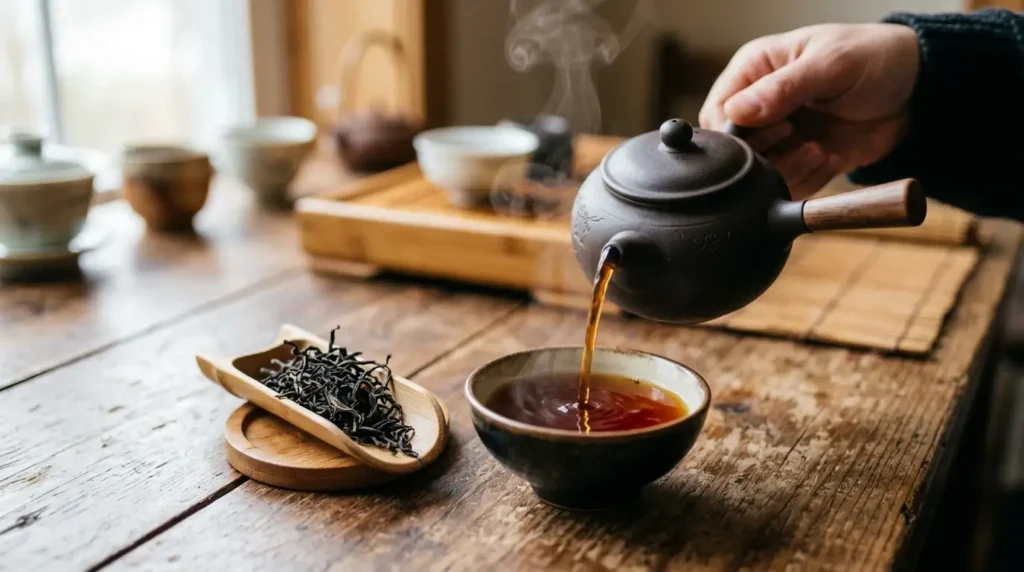
The Western method — a single, longer steep in a standard teapot — is perfectly good for everyday enjoyment. Lapsang souchong can be drunk with a splash of milk (which softens the smokiness) or completely black. Unlike many teas, it is not typically sweetened with sugar in Chinese tradition, as its natural sweetness is considered part of its character.
Food Pairings Inspired by Chinese Culinary Use
In Chinese cuisine, lapsang souchong plays a unique dual role as both beverage and ingredient. It is used to smoke duck (茶熏鸭, chá xūn yā), flavor tea eggs (茶叶蛋, chá yè dàn), and add depth to stocks and braises. This culinary versatility reflects the tea’s character: bold enough to hold its own against strong flavors, nuanced enough to add complexity without dominating.
As a beverage pairing, lapsang souchong is exceptional with:
Roasted meats and smoked foods (the smoke calls to smoke)
Strong cheeses, particularly aged varieties
Dark chocolate and chocolate desserts
Savory, salty dishes — its lack of bitterness makes it highly food-friendly
Spiced foods where a bold tea can stand up to big flavors
Frequently Asked Questions About Lapsang Souchong Tea in Chinese
What is lapsang souchong called in Chinese?
In Mandarin Chinese, lapsang souchong is called 正山小種 (Zhèngshān Xiǎozhǒng), meaning “Proper Mountain Small Varietal.” The Western trade name “lapsang souchong” comes from the Fuzhou dialect and roughly means “smoky pine wood small sort.” Both names describe the same tea — one emphasizing its geographic authenticity, the other its defining production method.
Is lapsang souchong the world’s first black tea?
Yes, it is widely considered to be. Originating in the Wuyi Mountains of Fujian Province during the Qing dynasty (17th century), lapsang souchong predates all other black teas. Keemun, Assam, Ceylon, and other famous black teas were all developed using techniques derived from Fujian’s black tea production methods.
Why is lapsang souchong so smoky?
The distinctive smokiness comes from the traditional production process, in which tea leaves are dried and smoked over burning Masson pine (松木, sōng mù) fires. The pine resin releases unique aromatic compounds — particularly longifolene — that are absorbed by the leaves during smoking. These compounds exist only in pine smoke and are not found in any other type of tea, making lapsang souchong’s flavor profile completely unique.
Is authentic Chinese lapsang souchong different from commercial versions?
Significantly so. Authentic 正山小種 from Tongmu Village in the Wuyi Mountains is produced in small quantities using traditional hand-processing and natural pine-smoke drying. Commercial versions sold widely in tea bags often use artificial smoke flavoring or are heavily smoked to mask lower-quality leaves. For the genuine experience, look for tea labeled specifically as “Zhengshan Xiaozhong” from a specialty tea supplier who sources directly from Fujian.
Can lapsang souchong be brewed multiple times?
Absolutely, and this is one of its great pleasures. High-quality Zhengshan Xiaozhong can yield 5–7 infusions when brewed gongfu-style. Each infusion reveals a different dimension of the tea — from sweet and fruity in the early steeps to deeper, smokier, and more mineral in the later ones. This multi-infusion quality is highly valued in Chinese tea culture and is a hallmark of premium-grade lapsang.
Does lapsang souchong contain caffeine?
Yes. As a black tea, lapsang souchong contains caffeine — approximately 40–60mg per 8oz cup, which is roughly half the caffeine of a standard cup of coffee. This makes it a satisfying choice for those who enjoy a moderate caffeine boost without the intensity of coffee or the higher caffeine levels of some espresso-style teas.
Conclusion — A Cup of Chinese History in Every Sip
Lapsang souchong tea in Chinese culture is far more than a flavoring curiosity or a novelty for adventurous palates. It is a living artifact of Chinese history — born from crisis, shaped by geography, carried across oceans by the early forces of global trade, and still produced today in the same remote mountain village where it was first created centuries ago.
The Chinese name 正山小種 (Zhèngshān Xiǎozhǒng) carries the entire story in four characters: an authentic mountain, a distinctive varietal, a commitment to origin. Every cup connects you to the misty peaks of Fujian, the resinous smoke of Masson pine, and a tradition of tea mastery that stretches back to the Qing dynasty and beyond.
Whether you encounter it as a bold standalone tea brewed gongfu-style in a small clay pot, as a warming companion on a cold evening, or as an intriguing ingredient in a smoky culinary creation, lapsang souchong rewards curiosity with depth. The smoke is not the whole story — it’s the beginning of a conversation with one of the world’s most remarkable teas.
If you haven’t explored authentic Chinese lapsang souchong yet, there’s never been a better time. Seek out genuine Zhengshan Xiaozhong from a reputable specialty tea source, brew it with care, and prepare to be transported — all the way to the pine-covered mountains of Fujian, where the world’s first black tea was born.
Black Tea Extract that is rich in natural theaflavins and polyphenols that help protect your body from free radicals, promoting overall immune health and well-being
Contains blended amounts of Fruits and Veggies. All natural, with whole foods, fruit and vegetable supplement.Perfect for everyone looking to live a healthier lifestyle.